|
|
| SIX TO TEN MILES A DAY The words just quoted well express the utter disregard of accident or misfortune to the average adventurer. We had been buffeted from one side to another so many times just ahead of so many fatalities that we were accustomed to threats of calamity. We hauled everything out of the boats, made up a camp on the island and stayed there for two weeks until the river all around us had set fast. Now we could reach the mainland. The agent at the fort had seen us through his spyglass in our first predicament in the ice jam. Knowing of the bad places below us in the river, natives were sent to follow along the shore to be of assistance if needed. They watched down to the fish camp and mouth of our river, not knowing that we had put into the island. They returned to the fort and reported us drowned and our outfits lost. The outside mail was dispatched from the fort as soon as the ice was safe, taking out the news of our disaster. This was published in the coast papers; these papers reached me the following spring. This item reached the newspapers of the Middle West, where my mother read it. With a mother’s intuition she would not believe it. When she heard from me later the news confirmed her convictions. When the ice set hard enough, we mushed to the main shore and down to the main camp. On the way we passed an Indian camp and learned that we were reported to have drowned. One of the Indians went back to the fort to report the truth. The old prospectors had already begun to mush their outfits by dogsleds, having to double-trip it, pulling a load up ten miles, leaving that load and returning to camp the same day. Our mishap in the river have us the task of hauling our outfit to the fish camp by main strength and hard pulling over 20 miles of the roughest trail in that country. After this was done we were to move on to a point 175 miles on up the river with our camp, some grub and dog feed, enough to last us for the return trip. For three hungry people and two dogs it was no small item. Jay got in and helped his two dogs pull his lead, and I got in and pulled mine personally day after day for three weeks. We pulled and worked, averaging six to ten miles a day. The trail left by the other boys would be entirely snowed under in some places; if they had not always followed the river we might have lost them entirely. About 50 miles from its mouth the river runs through a flat low country for 30 miles or more. Here we found some 20 different channels that had been cut by the spring floods. They all have about the same amount of water and when they freeze up in the fall it is almost impossible to locate the right channel. This stretch of country caused us much anxiety as it is the easiest thing in the world to get lost when the trails are covered with snow. In many places we would follow up the stream where we could see a brisk current flowing under the ice, then come to an abrupt ending and a gravel bar ahead with the snow blown off… a nice trail to pull a load over. The water that feeds these side channels runs under the loose gravel bars from the main channel above. Immediately below the bars when it comes out, the temperature of the water is several degrees above the freezing point, which leaves a space of open water of 100 feet or more before it again gets cold enough to freeze. We encountered a number of these places. In the northern Yukon flats the sun appears to be riding on the southern horizon for an hour or so at mid-day, then disappears. In the mountains it is twilight for a short period. One beautiful morning before sunrise when the thermometer was around 40 degrees below zero, we were mushing along through a foot of soft snow. I was ahead of the dogs breaking trail with snowshoes, when suddenly and without warning the ice broke under me, and in I went, up to my shoulders. It was only by a streak of luck that the dogs didn’t plunge in on top of me with load and all. Jay fished me out, took the load off the sled and put me on it; then we started on the run for camp a half-mile back. We had left Jay’s wife with the tent, stove and a few other things for our next load upriver. Long before we reached the tent my clothes were frozen stiff as a board. Jay’s wife had kept a good fire going in the tent and I was thawed out enough to take off my ice-coated clothing. "Fortune sometimes favors the poor." While we were wandering over these dead channels we came to a small body of open water in a sort of basin on a large gravel bar. During the spring floods the surface of these bars are all under water and it is then that the run of early salmon takes place to the heads of streams. Whether it is the undercurrent off warmer water or some other attraction for the salmon, this pond acted as a fish trap. It was alive with king salmon. The drop in the flow of the spring floodwater leaves this basin isolated, as there is no outlet except through the gravel bars. There were so many salmon there that the report of a gun would start them jumping over one another endeavoring to get away. Thousands would be thrust out of the water onto the sand. Tons and tons of frozen salmon lay by the shores, crowded out of the water by its receding. On the bottom of the basin there were fish bones two feet deep. We camped there for a few days, until we had killed enough fish with sticks (also shot some), to feed 23 dogs for six weeks and hauled 300 salmon 20 miles upriver for future use. During those few nights while stopping at the fishpond, we feared nervous prostration from howling wolves, foxes, wolverines and vultures. Seemingly only a few paces from the tent there were hundreds of them barking and fighting all night long. During the winter this fishpond attracted all the meat-eating animals of this district. Thousands of the musical talking ravens also made it their headquarters. In the scores of years that the Indians had passed up and down that river none had taken the cut-off route that we had and they had not known of the existence of this fishpond until we told them. They then realized the cause of so many animals gathering in this section. The snow around the edge of the pool was beaten down with the tread of many feet ' especially wolves and wolverines- the latter’s tracks in many cases as large as a plate. White foxes were also abundant on the river but not in the locality of the fishpond, as they were driven off by the larger animals. Their haunts were under the overhanging shore ice, where they were safe from all enemies, man or beast. One thing that struck us as rather queer at first was finding all sizes of boulders, frozen in the center of ice that was four feet or more thick. We also saw small fish caught in potholes and frozen into the solid ice in the same manner as the rocks. For miles and miles we passed over rocks weighing hundreds of pounds incased in the ice. Later we had occasion to see how this had occurred. In early winter the shallow parts of the rivers freeze to the bottom, and during extra cold snaps the mountain springs almost cease to flow. When the weather moderates and the springs start flowing, the water would flow down and raise the ice from the bottom, lifting with it large boulders and gravel. A FIGHT ON THE LONELY TRAIL WE FINALLY got to the mountains, after we had sighted them for several days and each day thinking that they were only a short day's journey ahead. The first thing that attracted our attention when we entered the big canyon was a column of smoke curling straight up. This smoke seemed to be about five miles ahead of us. We thought it was the other boys and proceeded to hurry to the end of our long journey. Arriving at the place of the smoke we found only a camp of mountain Indians. Here we found grown men and women, who had never been to the Yukon River, never had seen a steamboat or a white man; in fact, very little of anything except what other Indians had bought or taken up there, or what an occasional prospector had with him while passing through their country. One of the Indian men could speak a little English, and we managed to understand each other fairly well. There were about 60 all told in the camp, from old men and squaws to infants strapped to boards. About nine-tenths of them were dressed entirely in skins and furs. Their tepees were made of skins; in fact, everything they had was made from whatever they had gathered in the mountains. They lived entirely on meat and fish the year around. Only when they went to the trading posts with furs for sale did they bring back ammunition, tea and tobacco in exchange. Their supply of tea and tobacco had long been exhausted when we met them , but they had plenty of fresh meats, so we made the trade with them. A prospector usually travels with plenty of emergency tea and tobacco for such purposes so we were prepared.The thermometer was registering around 45 and 60 degrees below zero then, and those little Indian boys with their moose skin shirts open in front and barehanded would play outside by the hour and never notice the cold. This tribe would move every five or six days, to a new locality, and in this way keep up with the game. After a day's stay we continued on our journey upriver to a point 40 miles above the camp. Here we caught up to the other fellows, while they were making a cache of their grub. They were establishing headquarters here to work from. Here we rested up for a week. We were five days making the trip down. Having so much outfit it took 14 days to get it moved up to the headquarters point, making double trips all the way. One night I neglected to put my snowshoes up in a tree out of reach of the dog-- and the next morning there were only the wood frames left. All the gut lacings had been stripped out. I had to cut down a small fir tree, and make a pair of short skis before we could leave camp. Jay was an Englishman, very quick-tempered, always sure that his opinion on all matters was the most logical and he could not agree with anyone on a subject without getting very angry at the other fellow for not seeing his point of view. I soon decided that if we expected to travel together peacefully I must not antagonize him in any argument. In other words, his was always the right way and his arguments were always the most convincing. We would leave our camp in the morning and haul a load upriver about eight or ten miles, make a cache of it and return to camp by night. The next morning we moved camp and all to a point about 20 miles up the river to make a night camp. Next day we returned downriver to pick up the first load and haul it to the new camp. Jay drove one team of 12 dogs and I the other 11 dogs. It kept Jay's wife busy in camp preparing food for us and the animals. To prepare the food for that bunch of 23 hungry husky dogs required some time as each meal consisted of 4 five-gallon cans full of boiled corn and oatmeal with plenty of fish in it. It was customary to feed the trail dogs once a day, this meal at night. We gave each dog half of a thawed salmon for breakfast. One morning while we were loading our full camp outfit and in a hurry to start early on a 20-mile pull, our cook arranged a noonday lunch and packed it on top of a load on a sled. While doing this, Jay was in a somewhat cantankerous mood, scolding his wife for no apparent reason, until she got so excited she misplaced some of the lunch. Up on the trail we stopped for noon and built a fire while the cook got out the grub, but she couldn't find the biscuits she had made ready that morning. After looking through everything it appeared as though they had been left behind. Then is when Jay showed his real makeup¾ he lost his temper and exploded--for he grabbed up his dog whip and started for his wife, saying. "I'll learn yuh to forgit any more of my grub by giving yuh a **** good lickin'." I was standing on the opposite side of the fire and just stepped across it and in between Jay and her and said: "No, none of that, Jay, not while we are on the trail." He said: "You keep out of this, I'll do as I **** please." "Oh, no, you won't," I said, "not to a defenseless woman for a trifling matter like this." "Get out of my way," he yelled and raised the butt of his dog whip to hit me. I grabbed it in one hand and struck him in the face with the other so that he stumbled and fell back into the snow. That sock brought him to his senses. He lay there for a minute or so, then looked up at both of us and finally said: "I guess I was a little hasty," and got Right then I said: "Jay, I've realized for a long time that you were possessed of an ungovernable temper and I always gave in to your every wish and opinion. This is a big country; there are no men within hundreds of miles; a man could kill another and leave his bones to be picked bare by the wolves and no one would ever know about it. To avoid any chance of your losing your temper again, I am going to pack both of our rifles on my sled." He then tried to assert his authority. Being a brother-in-law of the man that owned the dogs, he said we would dissolve partnership right there. We would divide the grub and outfit 50-50, he to take both teams of dogs and I could do as I pleased. I would not agree to that proposition. I "We will divide the outfit; you pull your part with one team and I mine with the other," I said. Shortly after our squabble over the wife-beating incident the wife discovered the biscuits tucked away in the oven where she had hurriedly placed them that morning and had forgotten them. When he saw the biscuits he felt pretty small but was far too stubborn to say a word about the incident. We stayed in camp two days while making the division of the outfit. He owned the tent and I owned the stove. I had to make a tent out of an old tarpaulin and sail canvas. Jay made a stove out of old tin cans, the contents of which were emptied into cloth bags. We then had two separate outfits and mushed day after day together and camped quite near each other at night, but with separate campsites and fires. While we were hauling our outfit upriver with the dogs, the other boys had taken their camp outfit a few miles up the river above the headquarters camp and stayed for a few days. When they returned to the headquarters camp they discovered that a wolverine had been at their strongly built log cache. A LONELY WOLF-HAUNTED TRAIL The wolverine had tugged and worked and had nearly succeeded in prying out a big log. The timely appearance of the boys is what saved their winter's grubstake from being carried away or spoiled so badly that it would be practically useless. A day or two after reaching the headquarters camp, allowing the dogs to rest, the old-timers took their dogs and returned upriver to their camp to start prospecting a creek there. I returned Jay's rifle to him. Along with a few words about that overbearing temper that possessed him at times. Jay and his wife struck off upriver with his two dogs to prospect his own creek, while I pulled my outfit five miles up on another and started in prospecting. Building a half-cabin with logs that I found, I put the tent on top, and lived there for ten weeks alone. There was an abundance of dry wood in the country. Wood had to be cut and deviled down from the mountainside to the prospect hole for thawing the dirt. (Deviling wood is sliding it downhill with one end on a small makeshift sled and the other end dragging.) I would put in a fire at night, which by morning would have thawed down about two feet. Clearing it out in the morning, I put in another fire and cleaned out at night and so on. It does not go so bad single-handed until the hole gets 10 or 15 feet deep. Then the dirt has to be thrown up on a stage halfway up in the hole, then again thrown to the top. When a fellow has to handle the dirt three times, throwing it from one stage to another over his head, he begins to realize what real prospecting is. Alone I sunk two holes, eighteen feet deep, and found only one color. Fort Yukon is on the Arctic Circle. This locality we were prospecting was miles north of the Arctic Circle. There for about four months the sun never gets above the horizon; it is dark 18 hours and twilight for the other six hours each day. To save on my candlepower I used the fire in the stove for light to read by. I had taken along two magazines and one book; I read them from cover to cover, upside down and backwards. We had left Fort Yukon without a calendar. I made one, and each night I crossed off a date. In that way I knew when it was Christmas. My Christmas turkey was a pot of beans and bacon, biscuits, coffee and syrup. The blizzards would howl down those gulches, whirling the snow so that I often had to dig out the tent to keep it from caving in on me. A blizzard would visit me about once a week and last about two days. That was when I had to stick tight to the old tent. The Indians taught us how to tell the time by the stars. It was dark so many hours of the 24, that in order to do any work, or be on the trail, it was necessary to know about what time to start. The stars forming the Big Dipper served as our clock. In the evening about six o’clock, the Dipper was right side up; at six a.m. it was bottom-side up. The locality was so far up north that the Dipper was almost straight over our heads. Satisfied that there was no pay dirt in this creek, I moved my camp up over the divide, down onto another creek about 15 miles farther north, and thawed down two more holes to a depth of 20 feet each before bedrock was reached. No paydirt yet. The usual four gold colors was the result of the prospects. I thought of moving on still farther¾ to try it again. But on sizing up my grub I saw that I could not venture any further away from my main river grub cache. It was on that mush back for more grub that I was overcome with an all-consuming desire
to see my fellow men¾ to see and talk with somebody¾ to be among the human race again. After spending ten weeks
in solitary confinement without seeing a living thing except an occasional ptarmigan on
its flight down the creek, a man will get the habit of talking to himself at times instead
of thinking. So I decided to take a trip back to Fort Yukon to see the boys and
civilization, only 170 miles away, away, and let further prospecting wait. It had been ten
weeks since I left Jay and his wife at the main Loading my bedroll and about 15 days' grub onto the sled, I started out alone downriver. On the mush back I made an average of 24 miles a day, going the 170 miles in seven days. The condition of the river trail had changed very much since we passed over it on the way up three months before. For miles and miles the river had overflowed and frozen again, in places it was solid but patches had only a thin layer of ice which was sometimes covered lightly with snow. To have walked into one of these overflows, if only a foot deep, would surely mean frozen feet before one could reach shore and get a fire started. Other stretches of ice lay windblown and clear of any snow. It was on the latter kind of ice that one could make time. With my lightly loaded sled some days I made 30 to 40 miles. On other days, ten miles was the best I could do on account of poor light, overflows and storms. The overflows often caused the ice to heave up, making it impossible to travel. The fact that I had no gun now made me all the more timid. At several places on the river I came upon fresh tracks of wolves and wolverines which were on the trail ahead of me. The wolverine tracks can be mistaken for the grizzly bear, but knowing and feeling confident that there were no grizzlies in that region gave me courage. It was not without many anxious hours of travel, with fear of being attacked by a band of wolves, that I passed those localities. When I made camp at night, I would lie down to sleep behind a barricade of pine boughs on one side and a big log fire on the other. About half way down the river I came to a huge pile of driftwood that had lodged at the head of a small island during floods. There were thousands upon thousands of heavy stick timbers in that pile. Through a mere fancy to see a big fire, for I knew it could not get across the wide river channels surrounding it onto the mainland, I set the pile on fire. It did no harm other than deprive the wolves of a hiding place. The next spring flood would pile the island full of fresh stick timber again anyway. After lighting the fire at noon, I stayed there for a couple of hours to see it well started, then took the trail again. That night I camped about ten miles downriver. At my camp the sky was lighted up almost enough to read by, and for three days I could see the column of smoke curling up into the sky 60 miles away. I was traveling now in the Yukon basin, which is a flat country and no doubt originally was a vast lake about 250 miles across, until an outlet was cut through at the Ramparts at the lower end. Circle City is on the upper end at the end of the mountains, where the Yukon River enters through a deep canyon and spreads out into a half dozen different channels. Copyright 2000-2005, all rights reserved |
 Synopsis: In 1897, a party of young men, all under
age 27 and from widely divergent backgrounds, decided to make a run the for the gold rush
by way of Edmonton and the water route better known as the "back door to the
Klondike." The first part of their journey was full of the hardships these tenderfeet
endured while making their way to Ft. McMurray, Lake Athabaska, Ft. Simpson and finally to
Ft. Yukon. Dobbin, one of the party, has written of his experiences in a matter-of-fact
way, without heroics but giving due credit for his survival to the party’s
"courage can" (whiskey) and to the conviction of youth that "Every man,
going along living his life, conceives himself to be immortal. Death, the great accident,
is something which happens to the other fellow." Dobbin’s was a bleak and frozen
world—but he kept going because over the next snowy pass, beyond the last village of
starving Indians, somewhere at the end of the McKenzie was gold.
Synopsis: In 1897, a party of young men, all under
age 27 and from widely divergent backgrounds, decided to make a run the for the gold rush
by way of Edmonton and the water route better known as the "back door to the
Klondike." The first part of their journey was full of the hardships these tenderfeet
endured while making their way to Ft. McMurray, Lake Athabaska, Ft. Simpson and finally to
Ft. Yukon. Dobbin, one of the party, has written of his experiences in a matter-of-fact
way, without heroics but giving due credit for his survival to the party’s
"courage can" (whiskey) and to the conviction of youth that "Every man,
going along living his life, conceives himself to be immortal. Death, the great accident,
is something which happens to the other fellow." Dobbin’s was a bleak and frozen
world—but he kept going because over the next snowy pass, beyond the last village of
starving Indians, somewhere at the end of the McKenzie was gold.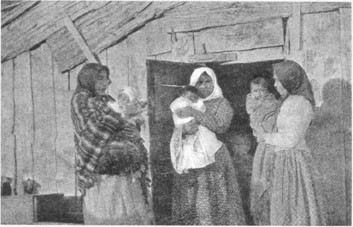 river. When I
arrived there with my sled and bedroll, the same band of Indians that we met before were
in camp there. I powwowed with them for a day, trading all my extra grub, rifle and
ammunition, tent, stove and everything else that I could spare, for a pair of moose skin
pants, gloves, two pairs of moccasins and a pair of snowshoes. The Indians reported that
the other boys had gone on up the main river about 100 miles and were still prospecting.
river. When I
arrived there with my sled and bedroll, the same band of Indians that we met before were
in camp there. I powwowed with them for a day, trading all my extra grub, rifle and
ammunition, tent, stove and everything else that I could spare, for a pair of moose skin
pants, gloves, two pairs of moccasins and a pair of snowshoes. The Indians reported that
the other boys had gone on up the main river about 100 miles and were still prospecting.