|


Because life has
changed a great deal over the last century, and because
our family is scattered a long way from its roots, I
asked our cousin Dean McClure if he would write
something for us about life in rural Missouri when he
was young. This page is the result of that
request, and he did a "bang-up" job of it, too. He
has given a very clear picture of what life was like on
a farm in the first half of the 20th Century, so that
all of us can see just how very different life has
become today. I hope all my children,
grandchildren, and their children, will read this
carefully, and think about what it would be like to live
as our grandparents and parents lived.
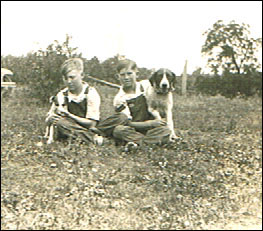
Photos below: Top photo is of cousin Dean McClure
(our author) and another cousin, Bob Barckley, evidently
on one of the family farms when they were 10 or 12 years
old, so it would have been taken in about 1935-1937 or
so, just shortly before I was born in 1938.
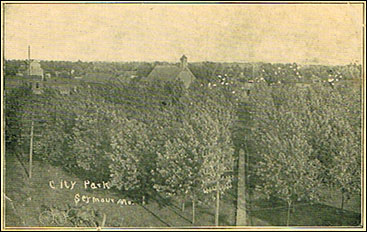
Bottom photo is of the park, or possibly town square, in
Seymour, Missouri, the town nearest to Dean's family
farm, a distance of about 7 miles apart. The
location in a broader sense, is east of the town of
Springfield, in south-western Missouri, near the Ozark
Mountains.

Rural Missouri Life in the First Half of the 20th
Century
Since I was born
in 1925, my early life, living on a farm in rural
Missouri, took place during the period they now call The
Great Depression years; the drought years, and the
locust and grasshopper infestation years of the 1930’s
and early 1940’s, none of which were years to be fondly
remembered. Most every family was financially poor and
life was very hard. But, living on a farm, we didn’t
have to stand in a “bean line” for food as many people
did who lived in cities. That helped to keep our
spirits livable.
However, during
the drought years life was pretty miserable! Not only
did the heat burn up our crops, the nights were so hot
and dry that we had to sleep out in the yard with a wet
sheet over us that cooled us as it dried. The locust
and grasshopper years were bad also; hordes of the
creatures would fill the sky, then would move into a
field, covering a crop and stripping all of the
vegetation, i.e., a corn field would be left just a
field of stalks with no blades, no kernels left on the
cobs, etc. And, when we were working in the hay, we even
had to carry our pitchforks to the house while we ate
lunch or these voracious insects would literally gnaw on
the wooden handles so badly they were left covered with
splinters.
For many years
(until after WW II) most farmers were poor, with farms
that were small and diversified; usually with dairy,
beef, hogs and chickens. Their crops were hay, small
grains, and a little corn. The dairy, hogs and chickens
were very confining, requiring feeding and care twice a
day (Saturday and Sunday also), so you couldn’t leave
home for long. But, since most of our food was “home
grown,” we could have an assortment that produced a
variety of foods not only for us, but some of it could
be sold for a much needed cash income.
Electricity was
not available until 1946, so refrigerators, well pumps,
milking machines, furnaces, air conditioners, and even
electric lights or a fan could not be used. The lack of
tractors, combines, corn pickers and other powered
equipment meant all of the planting and harvesting had
to be done with horse drawn equipment or by hand,
usually using pitch forks, shovels, etc. We had plenty
of grass, so four-legged horsepower was used for
plowing, cultivation, mowing, and in some cases,
traveling to town for groceries, to have livestock feed
ground, or to go to church (for two years after we
got a car, money was so scarce that we couldn’t afford
to buy a car license until July, when they could be
bought for half price, about $3).
Living on a
farm did have pluses; we had a large garden during the
summer and we canned much of it for the winter months.
We had milk, cream, butter, cottage cheese, and meat
from the cows. We had fresh pork when we butchered, as
well as smoked, salted, or sugar-cured pork for winter.
We had eggs and chicken meat, fresh during the summer or
canned in winter, and wild blackberries and gooseberries
for jams, jellies, cobblers and pies, just to mention a
few.
Our area had
several large fruit orchards full of apples, pears,
peaches, and grapes, and usually we could pick our own
fruit for a reduced price. Most fruits were canned or
dried for winter use. The dried
fruit was wonderful for “turnover pies” but it was very
time-consuming to dry it.
First the apples and peaches
had to be cut into slices. Each morning a bed sheet was
spread on a metal shed roof, and then the fruit had to
be spread out on this sheet to be sun-dried. Before
doing our chores every evening, we had to gather all of
it up and take it inside in case it rained. It took
several days of this for each batch of fruit to be
dehydrated enough for preserving.
Sugar cane
(sorghum) blades had to be stripped from the stalks,
then the stalks were taken to a sorghum mill for
squeezing the juice out and cooking it down into
molasses (we usually kept 6 or 7 gallons for cooking and
table use). We had many black walnut trees and walnut
kernels were a good source of income for us to buy
sugar, coffee, etc., that could not be home grown.
So, during the winter months, a part of our
“entertainment” was sitting around the table at night
picking walnut kernels out of the shells.
All water for
family use – cooking, drinking, bathing, washing dishes
and clothes, had to be carried from a spring, drawn from
a well, or hauled to the house and inside, in some
manner. During the drought years, many farmers also
had to haul water in barrels to water their stock and
for their gardens and fruit trees. Our water source was
very cool spring water located at the foot of a hill
about 3 or 4 city blocks from the house. This spring
was also used as our refrigerator to preserve milk,
butter, and other foods that had to be kept cool. The
food had to be carried down the hill to the spring to
keep it cool until the next meal, then water and the
food both had to be carried up again for cooking and
table use at every meal. Those trips will help you
maintain your “girlish figure.” The large quantity of
bathing and wash water usually was hauled on a sled with
a 90-gallon barrel, pulled by a horse.
The lack of
electricity meant that we had to milk 14 to 20 cows
twice a day, all by hand, which is not a small job
in itself, but then this milk had to all be processed.
(1) It must be
strained and cooled if being sold for cheese. Cooling
required the cans to be taken by two-wheel cart (Guess
where?); yep, down over the hill to the spring and
cooled. This doesn’t sound like an insurmountable
job, but our milkman was a farmer also and he was always
in a hurry to get home, so he could get more farming
done. We happened to be the second customer on his
route, so he tried to get to our place by 6 a.m.
Now, the cheese gets more binding. This meant that we
had to find our cows (in the dark) between 3 and 4
o’clock in the morning, milk by kerosene lantern, run
the milk down to the spring and cool it before he came,
or…
(2) The cream
could be separated with a “hand-cranked” separator twice
a day after each milking, and only the cream would be
saved for a week, and then taken to town to be sold.
The skim milk was usually mixed with shorts (a
wheat flour by-product) and left to ferment until the
next day, then fed to the hogs and chickens. Of
course, the hogs thought they were in “hog heaven” and
they would literally run over you to get to their food
in a trough. Also, to eat,
they would stick their snout down into the liquid mash
“up to their eye balls” and slurp so loudly you could
hear them for a hundred yards.
The laying hens
were fed “hand shelled” corn with some protein feed plus
oyster shells to promote egg production. For baby
chicks, a few could be hatched under a setting hen, or
for larger quantities (100 to 500), commercial brooders
were used. Brooders require constant controlled heat
and the eggs have to be turned daily for three weeks.
The pullets (baby hens) were used for replacement in the
hen house and the young roosters were sold or butchered
when they were old enough. Butchering requires them
to be caught, killed, scalded with hot water and the
feathers picked off (plucked), then the meat cut up into
various pieces. If it was to be canned, the meat had
to be partially cooked before putting it in the jars.
We had several
timbered areas, so we heated our
home, and cooked, with
wood. Now, these trees
don’t harvest themselves. They have to be cut down,
limbs trimmed off, and the trunk cut up into lengths
that can be loaded and hauled on a wagon to the
woodpile. Later, a fellow with a gasoline-powered saw
came to saw the logs into firewood lengths; this
operation required several neighbors to help. This is
just the preliminary work. Every night, enough wood had
to be carried or hauled to the house for the heating
stove to burn all night and the next day, plus some had
to be split and carried for the cook stove.
Butchering hogs,
beef, or chickens makes for a very long day, and part of
the night usually. In the case of hogs and beef, it
also is a very cold job. Working outside, scraping off
all the hair and cutting up the meat with wet hands, in
20 degree weather, is very unpleasant, but it had to be
done when the weather was cold to keep the meat from
spoiling until it could be preserved or canned. Some
things like sausage and fryer chickens had to be
partially cooked before canning. So, this was not a day
to work your shift and quit, nor was there overtime pay.
However, this food was very rewarding during the cold
winter months.
The wild
blackberries and gooseberries do not come in boxes or
sacks, ready picked, when you live on a farm. To
pick them, you have to fight the chiggers, the heat, and
the very sharp briars for every single berry. Then
the gooseberries had to be stemmed individually, at both
ends, before they could be baked into a pie or canned.
It required a whole lot of labor to harvest and preserve
food for winter usage, but if we wanted to eat, we had
no choice. In fact, we were quite thankful and much
better off than many people during those times.
Commercial radio
broadcasting was developed in the late 1920’s, but only
a few people had a radio receiver (because they were
tube operated that required three expensive,
special high voltage battery packs for operation) and
the only newspaper was weekly, so members of the
community had to basically entertain themselves. To
do this, one night each week our school was used for
what we called “Literary.” On those nights, we
might have a debate, a kangaroo court (mock trial), a
funny skit, a school holiday program, or a pie supper
(where the girls brought a pie and the boys bid on it to
get to eat with them). All of the programs were
volunteer; participants and admission was free, but
sometimes, a group would gang up on a boy at the pie
supper (who was sweet on a certain girl) and run his bid
up pretty high. It was all in fun and usually well
attended.
For several
years, my dad sang in a quartet with three farm
neighbors, and they usually got together one evening a
week for what they called “practice;” usually some
singing, but always a lot of visiting. We children were
relegated to the kitchen or outside in the yard to
entertain ourselves, and most of the time, we did that
very well without adult supervision.
For years, most
rural schools were a one-room building with one teacher
teaching seven grades. The 7th and 8th
grades were usually alternated. This one teacher, in
addition to teaching all of the subjects to
all seven different classes, was also the official
fire builder, the lunch monitor, the playground monitor,
program director for all holiday programs, room
decorator, and helper with coats, overshoes, and
hats. All of this for very low pay, and sometimes,
not many even said “thank you.” However, these teachers
could begin teaching after completing only a few
college hours, they did not have to have as much
schooling as they do today.
During the
1930’s, most rural schools put a partition across the
middle of their building to form two rooms and hired two
teachers; one teaching first through fourth grades, and
the other teaching fifth through eighth grades, and they
shared in the other duties.
We only lived
three-quarters of a mile from school but some
students lived as far as 3 miles. While most families
had a car, they didn’t have the money to drive their
children to school and there was no bus service for
rural schools. And, our school did not have facilities
for a horse, so that meant we had to walk both ways each
day. Actually, a stroll with other students that was
very pleasant on nice, warm, sunshiny days, but on
rainy days or during the winter months, with the wind
and snow blowing in your face, and heavy overshoes
weighting your feet in the snow or mud, the pleasure was
soon lost.
During the
1930’s, whisky was sold in half-pint and one-pint flasks
that were curved to fit in the rear pocket of farm
overalls. Our schoolhouse was located near a branch
(stream) of very cool water and we boys would find one
of those empty flasks, wash it out good, and carry it to
school full of milk to lie in the cool water and drink
with our lunch. The flask was a good fit in our pockets
also. With no soda pop machines and no cool drinking
fountains at school, this cool milk was a real treat and
those flasks sold or were traded among the boys for a
premium.
During the
1930’s, school bus routes were established for the High
School in Seymour, Missouri. Even though we only lived 7
miles from town and I caught the bus at 7 a.m., I did
not arrive at school until just before 9 a.m., when
school started. Those were very long days for me,
considering that I had to be up much earlier than
that to help milk and feed all the livestock, eat
and dress for school, ride the bus two hours, work at
school all day, ride the bus home (about 30 minutes),
help with all the evening chores, eat supper, pick out
walnut kernels, and then sleep a very short night. As
you can see, there wasn’t any time for just lazing
around, visiting with friends, or anything else, for
that matter.
From 1939 until
1941, the owner of our school bus (who operated two
buses) agreed to bus a load of us to the roller skating
rink in Marshfield (about 11 miles away) one night a
week. The rink owner agreed to reserve the rink for
us on that night with a special low rate. At first,
there was utter pandemonium, because out of the whole
busload, only 3 or 4 people could stand up on skates.
Even if you were able to go for a short distance, it was
a sure thing that someone would fall right in front of
you and then others behind them would pile on top.
Eventually, enough of us learned how to skate so we
could help others to learn. It became a community thing
and a very pleasant evening at the rink. In fact, it
became so popular that it took both buses and sometimes
2 or 3 cars to haul the entire group.
December 7, 1941
(when Pearl Harbor was attacked) changed the lifestyle
of our whole area. With some of the people going into
the service immediately and others taking jobs to help
the war effort, lots of marriages, and people moving to
other areas, etc., it was the beginning of the end to
our former way of life, one that was never to be seen
again.
Note: If you would like to send comments to Dean about
his story, use the email link below, and I'll forward
them to him. Thanks!


Copyright
© 2006
James and Marcia Foley, all rights reserved
Page
design:

|