|
This must have been the generation in which life in New Hampshire grew rather tame and civilized, because there was a decided wanderlust in the Folsom men during this generation. This Nathaniel did not wander... at least not permanently, but he was very active in his community and this was a time of great change for the colonies... they were on the eve of revolution. Nathaniel became very involved in the rebellion, as it was called, because he was interested in the community, politics, and business. From the Seacoast New Hampshire "Framers of Freedom:" His father died when he was 14, and he began working in business at a very early age, consequently. In those times it was appropriate for the family business to go to the oldest son, but Nathaniel was not a first son, so he had to "make his own way." In
addition to the normal formal training of the time, Nathaniel also took military
training. He had a good head for business, however, and was working
very successfully at that when things began to go wrong in the
colonies. He
began
early with an interest in the lumber field, and continued with it
sporadically throughout his life. In 1761 he formed a partnership with his
neighbors, the brothers Joseph and Josiah Gilman. "Folsom, Gilman and
Gilman" proposed "to keep a general store on a large scale, to
build ships, and to carry on foreign commerce." Though the firm
lasted only seven years Nathaniel continued in commerce well after that
period. In 1755, on the Crown Point Expedition of the French and Indian Wars, he commanded one of ten companies which marched through the woods to Albany and on to Fort Edward. His troops, well versed in ranger tactics, surprised the French troops of Baron Dieskau and, with the loss of only six men, dispersed the enemy and seized their baggage and ammunition. Folsom went on to become a colonel in the New Hampshire militia under Royal Governor John Wentworth. His royal commission was revoked when, following the raids at Fort William and Mary in December of 1774, he gathered his troops and marched to Portsmouth to guard the captured cannon and small arms until they could be transported up river to Durham. Nathaniel
was active in town affairs, too, serving as town meeting moderator and as
a delegate to the first Provincial Congress, which met in Exeter on July
21, 1774. This group elected him as one of two delegates to represent New
Hampshire at the First Continental Congress in Philadelphia. He was
elected to this post two times more in subsequent years, and Exeter
continued to send him to the Provincial Congresses. On
May 29, 1775, following the alarm at Lexington and Concord, the New
Hampshire Provincial Congress made Folsom commander of the re-organized
New Hampshire forces. Meanwhile John Stark, who was at Cambridge with the
New Hampshire men, had been named to the same post by the Massachusetts
Provincial Congress! This conflict endured until the Continental Army was
formed several months later, at which time a third man, John Sullivan of
Durham, was appointed to command the New Hampshire forces. Folsom remained
commander of troops within New Hampshire, tending to the recruitment of
men and the gathering of supplies.
More stories involving Nathaniel Folsom (as well as other stories about the Revolutionary War) can be found at the NHSSAR (the New Hampshire Society, Sons of the American Revolution) homepage at: http://www.sar.org/nhssar/index.htm New Hampshire's Constitution of 1776 http://www.sar.org/nhssar/essays/Constitu.html New Hampshire's Reaction to the Boston Tea Party in 1773 http://www.sar.org/nhssar/essays/TeaParty.html
THE
SEIZURE OF HIS MAJESTY'S FORT WILLIAM AND MARY AT NEWCASTLE, NEW
HAMPSHIRE, DECEMBER 14 - 15, 1774 by Thomas F. Kehr, President, NHSSAR (June 25, 2001 rev.)The State of New Hampshire possesses the unique distinction of being the only of the original thirteen states reputed not to have had an incident of armed conflict take place on its soil during the American Revolution. Or does it? Those patriots who participated in the little-known armed assault on, and taking of, a British fort on December 14 and 15, 1774, four months before the fighting at Lexington and Concord, Massachusetts, may disagree. Shortly after the French and Indian War (1754 to 1763) a disconcerting level of tension began to develop between the American colonies and the mother country. By the 1770's, colonists began to express their dissatisfaction with various aspects of British authority in America by passive resistance, near-treasonous communications, or outright aggressive action. Early actions by our patriot forebears included, but were not limited to, the burning of the armed schooner Gaspee in Rhode Island in 1772, and, as noted by our compatriots in West Virginia, the Virginia Militia's stand against Chief Cornstalk's native tribesmen during the Battle of Point Pleasant in October of 1774, an action which has been recognized as an engagement of the Revolutionary War. The flame of independence was, of course, smoldering in such locales as Boston, where in 1770, the slaughter of locals at the hands of the British garrison came to be widely publicized as the Boston Massacre. Unrest in the Massachusetts Bay Colony, including the 1773 Boston Tea Party, ultimately resulted in the passage of the Boston Port Act, which closed commerce in Boston Harbor, wreaking havoc on the city's economy. From Boston spread a rising level of organized revolutionary sentiment, carried northward to New Hampshire by groups such as the Sons of Liberty. In 1770, New Hampshire's young and popular Royal Governor, John Wentworth, prophetically opined that "[o]ur province is quiet yet, and the only one, but will, I fear, soon enter. If they do, they'll exceed all the rest in zeal."[1]. In March of 1774,
the New Hampshire Provincial Assembly, already sensing the potential
long-term importance of British military installations within the colony,
considered the matter of funding the garrison stationed at dilapidated
Fort William and Mary. The fort, located in the Town of Newcastle, New
Hampshire, guarded New Hampshire's primary seaport, bustling Portsmouth
Harbor. After some wrangling, the Assembly allowed funding sufficient to
provide for only three British soldiers and one officer at the fort. [2]
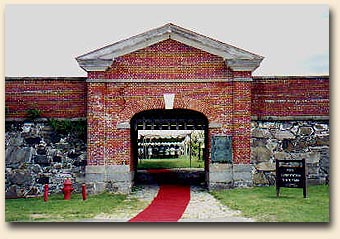
Following Governor Wentworth's protest that the allotment was On December 13, 1774, Paul Revere was dispatched from Boston with a letter from William Cooper of that city to Samuel Cutts of the Portsmouth Committee of Correspondence. Revere carried word that a royal order had been issued prohibiting the export of gunpowder to the colonies; that military provisions in Rhode Island had been moved inland by colonists for safekeeping, and that the British government intended to reinforce the tiny garrison at Fort William and Mary with soldiers of the regular army, or to remove the fort's powder. Upon his arrival in Portsmouth, Revere saw the familiar face of the aptly-named William Torrey, whom he had known in Boston, and inquired of him where Mr. Cutts could be found. Torrey directed Revere to Cutts and then waited for their brief meeting at a local tavern to conclude. Thereafter, Torrey asked Revere what word he carried from Boston and learned the contents of Revere's communique. [5] In prompt action attesting to the level of tension then existing in New Hampshire, the Portsmouth Committee immediately began to plan for the capture of gunpowder stored at Fort William and Mary. As they were doing so, it is likely that Torrey, a business partner of the Province's former Stamp Act agent (and later a prominent Loyalist), conveyed news of Revere's message to Governor Wentworth. [6] The Governor sent word to the garrison at the fort to be on its guard, to "examine every Person that came into the Fort, and to be vigilant against all Force and Stratagem." [7]. The commander of Fort William and Mary, Captain John Cochran, a native of Londonderry, NH, kept a close watch throughout the night of December 13 and may have added two men, the most he could recruit, to his regular contingent. [8] In December of 1774, Fort William and Mary (formerly known as "the Castle" and now known as Fort Constitution) was a sorry old structure, having been erected on Great (Newcastle) Island in the early 1600's to protect the approach to Portsmouth Harbor. The fort's history is one of intermittent refurbishment and decay. Although in late 1774 it was a low-walled stone enclosure garrisoned by only a handful of British soldiers, Fort William and Mary did hold over one hundred barrels of gunpowder, many stands of muskets and numerous cannon poised to defend New Hampshire's link to the Atlantic. At noon on December
14, 1774, members of the Portsmouth Committee marched through the streets,
led by fifes and drums, loudly proclaiming their plan to attack Fort
William and Mary. [9] It was open treason and Governor Wentworth's private
secretary, Mr. McDonogh, and the Chief Justice of the Province, Theodore
Atkinson, were dispatched to As the colonists marched toward the fort, Governor Wentworth ordered John Parker, the County Sheriff, to "send an Express for Intelligence of the Proceeding at the Castle." [12] Sheriff Parker could not find anyone willing to undertake the task. After ordering Sheriff Parker and two magistrates to attempt to "Suppress the Riot" - which they could not do - the Governor made plans, against the advice of his Council, to personally go to the fort in order to quell the mounting uprising. He called for his barge, but neither his own bargemen nor temporary workers could be convinced to take on the task of transporting him. [13] Wentworth had no better luck in attempting to call out the militia. As the Portsmouth men were readying to march on Fort William and Mary, Captain Cochran was visited at the fort by two Newcastle men, ostensibly concerned with a small matter of business. "It being very cold and not suspecting them of evil Designs," Captain Cochran "suffered them to sit by the fire." [14] Within a half hour, they were joined by another man, and "instantly" by three more. "Being all neighboring Residents," Captain Cochran stated that he "had no suspicions of any Plot or Intentions against himself or the Fort or any thing therein." [15] Within a few minutes, four or five other individuals appeared for a visit. At this point, Captain Cochran "first began to suspect there was some unlawful Scheme contriving" and recalled the Governor's order to examine every person who came into the Fort. He asked the visitors as a group what brought them there and was told that they were merely on a social visit. As Cochran was wondering aloud why they had never made a social visit before, his wife Sarah, who resided with the Captain and his children at the fort, came into the room, whispered that he should be on his guard and handed him his loaded pistols. Cochran decided to question the visitors separately. The first interviewee told Cochran that he was in fact on a social visit and that the presence of the other visitors was simply a coincidence. Cochran doubted the story and had the man escorted from the gate before questioning a second visitor. To the second man, Captain Cochran professed to already know their plan, insinuating that he had learned it from the man he had escorted out. Surprisingly, the Captain received the confession that the group was there to seize him. All of the visitors were immediately ordered out and Captain Cochran "instantly pointed three Cannon toward the Gate and other Places where I thought they would be most serviceable to prevent Persons from Coming in as I then began to be apprehensive a sudden Attack was intended to be made upon the Fort."[16] Within a few minutes, a local man arrived to offer his assistance in defending the fort from what he understood to be an imminent attack. Cannon and muskets were swiftly loaded, bayonets were fixed to small arms and other battle preparations were hastily made. Activity was interrupted by the coincidental appearance of yet another visitor - this one apparently on legitimate business. He was immediately pressed into service. [17] By this time, the armed mob from Portsmouth was fast approaching Newcastle. Captain Cochran posted his small contingent "in the most advantageous Station I could judge of, and ordered them not to flinch on pain of Death but to defend the Fort to the last Extremity, telling them that the Instant I saw any sign of Cowardice in either of them I would drive a Brace of Balls through his Body."[18] No sooner had Captain Cochran spoken these words then the area outside the fort was teaming with men. At about three o'clock p.m., a group of ten or twelve men requested entry. Captain Cochran declined to admit such a large number at one time. In apparent hopes of avoiding a bloody confrontation, John Langdon chivalrously offered to enter with one other man, to tell Cochran their business and to immediately exit the fort if the Captain then desired. The gates were opened to Langdon and Captain Robert White as the crowd outside repeatedly demanded surrender and threatened to put the soldiers of the garrison to death. [19]Once inside, Langdon and White bluntly informed Cochran that they were going to carry off all of the gunpowder in the fort's magazine. Keeping to military protocol, Captain Cochran informed the men that if they were going to take the gunpowder, he would need to see an official order to that effect from the Royal Governor. Langdon replied - probably with a smile - that he "forgot to bring his Orders, but the Powder they were determined to have at all Events." [20] Well aware of the potential for bloodshed and the initiation of wider American hostilities, Cochran replied that if this was the case, the waiting mob would have to take the powder by force and ordered Langdon and White out of the installation. As Langdon and White were departing, Cochran added that "if they attempted to come into the Fort their Blood be upon their own hands for I will fire on you." [21] Almost before Cochran had time to catch his breath, a signal was given to the colonials to storm the fort. Captain Cochran then fired what were arguably among the first shots of the Revolutionary War: musket fire and three cannon hurling four pound shot were directed at the American ranks. Colonists rushed toward the walls just as they saw the King's soldiers lighting the matches of their cannon, thereby slipping under the guns. As the soldiers sought to reload, the colonists pressed forward. "Before we could fire again," Cochran reported, " we were stormed on all quarters . . ." [22]. Incredibly, unless the wounded declined to publicize injuries sustained in an overt act of treason, none of the colonial rebels are known to have been injured from the fort's hasty volleys. [23] Risking injury, death and the initiation of immediate war with one of the world's great powers, hundreds of Americans stormed over the parapets of Fort William and Mary, destroyed some of the walls, and broke down the gates with axes and crowbars. The King's soldiers did not easily capitulate. In spite of at least thirty to one odds against them, the defenders of the fort resorted to hand-to-hand combat. Captain Cochran placed himself against the wall and "was pressed upon, but kept them off a considerable Time with my firelock and Bayonet." [24] He continued fighting with his bayonet after his musket was broken to pieces, wounding one unidentified American with a jab through the arm. [25] Ultimately, Thomas Pickering, a Portsmouth sailor, jumped from a wall onto Cochran's shoulders and grabbed the Captain by the throat, calling him his prisoner. Cochran knocked Pickering over but fell with him, seriously injuring his own wrist. He was immediately seized by a throng of men, one of whom demanded the keys to the powderhouse. Cochran replied that his attackers may as well ask him for his life, because he would just as soon part with that as with the keys. Seeing her husband being taken into confinement, Sarah Cochran courageously "snatch'd a bayonet and so spiritedly joined her husband, as to enable him to disengage, but they were both instantly overpower'd & disarm'd . . ." [26] Cochran was quickly confined in the fort's guardhouse and the door to the powderhouse was broken down with a crow bar. Meanwhile, the other soldiers of the fort were engaged in their own struggles against the intruders. Soldier Isaac Seveay was knocked from his position on a wall and disarmed. Seveay was located near the King's colors and Captain Thomas Palmer "snapped a Pistol" at him. The weapon was apparently either uncharged or misfired and the soldier was ordered to fall to his knees and beg pardon for resisting the attack. Seveay answered that he would kneel "when his Legs were cut off below his knees . . . but he would not before." [27] He was immediately knocked to the ground by other attackers and pummeled in the head with fists. In another area of the fort, Soldier Samuel Rowell observed - likely with great surprise - that one of the American rebels was "One Rowell, a soldier." [28] Soldier Ephraim Hall was disarmed both by men he knew and by strangers. Newcastle resident Abendigo Bell threatened that if he had a club, Hall would be unable to hold him back "for he would knock his Brains out." [29] At least some of the defenders' muskets were smashed to pieces in the struggle.As the soldiers of the fort were being disarmed, subdued, and imprisoned, the New Hampshiremen made it clear that their attack was not simply a "powder raid." With the fort in colonial hands, the men "triumphantly gave three Huzzas" and hauled down the British flag. Eyewitness reports credit this symbolic act, undoubtedly the first striking of the King's colors at a British military garrison captured by victorious American forces under arms, to John Palmer of Portsmouth, New Hampshire, the son of the man whose pistol misfired in the face of Private Seveay [30]. From the powderhouse, the triumphant Americans seized at least five kegs of bullets, several thousand gun flints and all but one of the King's barrels of gunpowder [31]. This booty was swiftly loaded into tidewater river boats known as "gundalows," and transported for hiding in various inland communities. Captain Cochran and his men were released after about one and a half hours of confinement. The unfortunate Captain Cochran likely faced mixed emotions when his aged father arrived at the ransacked fort for a visit on the very evening of the day that Cochran was released from rebel captivity. After returning from the raid, the rebel leaders called upon neighboring towns to assist in what had by then become open and widespread rebellion against British authority in New Hampshire. One of the supporters of the American cause who was contacted for assistance in planning a second attack on Fort William and Mary was Major John Sullivan of Durham, an attorney and delegate to the American Congress in Philadelphia who would later become a major general in the Continental Army and the president of the revolutionary body governing New Hampshire. Another was Nathaniel Folsom of Exeter, a French and Indian War veteran and, like Sullivan, a delegate to the First Continental Congress.After the attack of December 14, Governor Wentworth, a royal official generally sensitive to the views of the Province he administered, immediately sent word to General Thomas Gage, the military governor whose forces were then occupying Boston. He expressed, in surprisingly strong words, his view of the cause of the unrest. Wentworth wrote that about four hundred New Hampshiremen had "by violence carried away upwards of one hundred barrels of powder belonging to the King . . . I am informed that expresses have been circulated through the neighboring towns, to collect a number of people to-morrow, or as soon as possible, to carry away all the cannon and arms belonging to the castle which they undoubtedly will effect, unless some assistance should arrive from Boston in time to prevent it. This event too plainly proves the imbecility of this government to carry into execution his Majesty's order in Council, for seizing and detaining arms and ammunition imported into this Province, without some strong ships of war in this harbor. Neither is the Province or custom house treasury in any degree safe, if it should come into the mind of the popular leaders to seize upon them."[32] In spite of the somewhat sympathetic language contained in his letters to Gage, Wentworth did not shirk his duty as protector of the King's law. At noon on December 15, the Governor issued an order to enlist or impress into service, without delay, "Thirty effective men to serve his Majesty as a Guard & Protection to his Fort William and Mary at New Castle . . ."[33] Captain John Dennet of the First New Hampshire Regiment of the Provincial Militia took to the streets of Portsmouth and "caused the Drums to be Beat & Proclamation to be made at all Publick corners & on the Place of Parade."[34] The attempt to rally the loyal subjects of New Hampshire was a complete failure. Captain Dennet reported at six o'clock p.m. on December 15 that not a single person had responded to his plea for recruits and that he awaited further orders. The day after the attack, Portsmouth was crowded with men from nearby towns gathering into military ranks. Sheriff Parker was ordered by the Governor to tell officers of the Provincial Militia to call out their men, "which they pretended to attempt, but got nobody." [35] In fact, by noon, more than five hundred men under the command of Militia Major John Sullivan were in Portsmouth openly preparing for a second march on Fort William and Mary. Governor Wentworth called for Sullivan and asked what was going on. Sullivan replied that he had learned that two regiments of British regulars were being dispatched to Fort William and Mary and that these troops intended to turn the fort's cannon and arms on American colonists. Lowly Major Sullivan boldly informed his military commander, the Royal Governor, that he and his men intended to seize the weapons at the fort before they could be put to this use by British troops. Likely taken aback by the Major's startling candor, the Governor, in spite of his plea to General Gage for assistance, assured Sullivan that he knew of no such plans, labeled the rumor of incoming troops bent on reprisal a "wicked falsehood" and a "vile report calculated to alarm and lead the people into the most dangerous and destructive madness" and asked Sullivan to prevail upon his men to disperse. [36] Sullivan agreed to ask his men to go back to their homes but told the Governor he doubted that this was going to happen. By this time, upwards of a thousand New Hampshiremen, described by one writer of the time as men "of the best property and vote in the Province,"[37] had gathered in the seacoast community. The number of participants in the event is startling, considering that the usual population of Portsmouth was probably only four to five thousand. About an hour after meeting with the Governor, Sullivan returned and reported that he and a local justice had conveyed the Governor's message to his men. The throng seemed calmer, but were still determined to march. Sullivan suggested that if the Governor would pardon the Americans who had attacked the fort on the fourteenth, or at least issue an assurance that the perpetrators of the raid would not be prosecuted, his men might disperse and consider returning the confiscated gunpowder [38]. Wentworth told Sullivan that "I could not promise them any such thing; but if they dispersed and restored the Gunpowder, which I earnestly exhorted them to do, I said I hoped His Majesty may be thereby induced to consider it an alleviation of the offence."[39] Sullivan conveyed this message to his troops, but returned within a half hour, this time in the company of John Langdon and three other men. They repeated that they believed that a second seizure of the fort would simply be an act of self-preservation, and again suggested that their men may disperse if the Governor agreed to pardon or forego prosecution of those involved in the raid of the fourteenth. Wentworth not only made it clear that he would not make such an agreement but also announced that: ". . . it was the height of absurdity to Suppose this little Colony cou'd oppose the vengeance of Great Britain, or escape its just resentment for an insult upon its Honor and Government, which all the States of Europe wou'd not offer with impunity. I urg'd their impending destruction by every argument in my power, and concluded that I wou'd not hear or Speak any further. They departed & told the People assembled in the State House my Answer.[40]" Wentworth was hopeful that the situation would come to an end without further violence and "expected that the gunpowder would have been restored by the morning."[41] For a time, this seemed likely. The growing crowd gradually wafted into local taverns and drink apparently quelled their ardor for a second march. Indeed, after imbibing in a mug of flip, the generally aggressive Major Sullivan appears to have made a speech urging the growing crowd to return home. Others, however, spoke in favor of immediately reseizing Fort William and Mary. When the crowd gave three cheers and appeared to be dispersing, local patriots intent upon further action sent expresses to Exeter, Kingston, Nottingham and other towns seeking additional men to lend a hand in a second attack, " . . . [a]rtfully detaining the people & inflaming them with Liquor, until a Man arriv'd about 7 o'Clock informing that more than one thousand Men were on their march into Town, also six hundred from Berwick and Kittery in the Massa[chusetts] bay. Upon this Major Sullivan proceeded to embark His parties in gondulas . . ." [42] By the evening of December 15, 1774, New Hampshire's largest and most cosmopolitan town had been transformed into a tense and heavily armed rebel militia camp. The official ranks of the Provincial Militia were nowhere in sight. Rather, many of its members were armed in active support of the insurrection. As the Governor waited in vain for his loyal militia to act, Sullivan and his troops joined with the huge mass of men converging on Portsmouth from nearby towns. While on their way to Newcastle, Sullivan's band, which presumably included the "Parson of the Parish, who being long accustomed to apply himself more to the care of the bodies than the souls of his parishioners, had forgotten that the weapons of his warfare ought to be spiritual, and not carnal . . ." [43], received a message from Captain Cochran warning that Cochran would again fire on the rebels if they attempted to retake the fort. Hundreds of men - perhaps closer to 1,000 - descended on Fort William and Mary at about ten o'clock p. m. on December 15, 1774. Sullivan approached the gate and was allowed in to speak with Cochran. At a meeting in the Captain's house, Sullivan explained that his men - all men of property, he pointed out - would be seizing "all the Province stores" at the fort. [44] Much "warm Discource" ensued, with Cochran and Sullivan's raised voices being audible to the soldiers on duty [45]. Having been overrun by rebel forces only the day before, with his fighting force probably reduced even further than it had been on December 14, and facing an even greater multitude of rebels than he had previously, the injured Captain attempted to negotiate his way out of a second assault [46]. He nearly succeeded. Cochran drew a distinction between Royal and Provincial property, and " . . . consented to see a Committee of three of their People and to shew them what Stores might Possibly be put there by the Province . . . which consisted only of forty or fifty old useless Musquets and some inconsiderable small stores of no value, hoping by giving up these to save all the rest, having no power to defend them." [47] A committee consisting of Andrew McClary, Jeremiah Bryant and Thomas Stevenson - a group apparently ill-suited to their joint task - met with Cochran. At first, McClary attempted to speak for the committee but stammered so much that Cochran could not understand him.[47A] Bryant ultimately explained that they were a committee chosen by the Province to demand all Provincial stores from the fort. Stevenson apparently took issue with Bryant's statement even before Cochran could respond, arguing that they were not in fact a committee from the Province but were instead a committee from a body of about one thousand men then stationed nearby. Regardless of who they officially represented, Cochran showed the three what he believed to be Provincial property, identified items which were personal property and " . . . told them All the rest belonged to the King and warned them on their peril not to touch them" [48]. Bryant doubted that Cochran had shown him all Provincial stores, but the Captain explained that he was certain that he had done so because each item sent to the fort by the King - including the cannon - bore the King's mark. Bryant and Stevenson reported on their meeting with Cochran to the men outside.In about half an hour, approximately ten men led by Major Thomas Tash advanced to the gate and demanded the Province's arms and stores. Cochran replied that he had already shown them to the first committee. He also consented to let the ten men - but not the entire American mob - enter the fort to take away the Province's goods. This concession made a second capture of the fort a virtual fait accompli. Sullivan assured Cochran that the men who entered the fort would keep good order and Tash's group entered, receiving repeated warnings from Cochran that they "must not at their Peril Meddle with or take away anything belonging to the King . . ." [49] The men "generally answered [that] they knew that very well . . ."[50]. Cochran's faith in American respect for the King's property was misplaced. In what appears to have been an orderly, if not triumphant, second invasion of the fort, the original group of ten soldiers, soon followed by the other companies waiting outside, simply overran the installation and seized all of the small arms, bayonets, cartridge boxes, assorted cannon shot, and other ordinance stores that they could locate. In spite of Cochran's persistent, if unsupportable, warnings, they also seized sixteen of the King's prized cannon (fifteen four-pounders and a nine pounder), ten carriages, the useless muskets which Cochran had previously pointed out, and forty-two serviceable muskets with shot [51]. The comparative orderliness of the second raid was broken by Captain Cochran's visiting father, James Cochran. According to Governor Wentworth: ". . . when Major Sullivan was triumphing in the number, riches and prowess of his Party . . . The honest, brave old Man stop'd him short, call'd him and his numerous party perjur'd Traitors & Cowards, That his Son the Capt. Shou'd fight them two at a time thro their whole multitude, or that He would with his own hands put him to death in their presence, Which the Son readily assented to, but none among them wou'd take up the challenge. [52]" Although the raiders apparently made no attempt to permanently occupy the garrison and allowed seventy heavy cannon to remain in the fort, they worked throughout the cold winter night of December 15/16, tramping through frigid tidewater to load their plunder onto gundalows. The night's work was not completed until eight or nine o'clock on the morning of December 16, 1774, by which time Colonel Nathaniel Folsom had arrived from Exeter with a large contingent of heavily armed infantry and cavalry. Folsom stationed his troops as a guard, waiting for the tide to change. At the turn of the tide, the captured cannon and other stores were, with difficulty, shuttled up the ice-choked Piscataqua River for safekeeping in other towns. For the second time in less than forty-eight hours, a British military installation in America had been captured and sacked by colonial forces [53]. Before leaving Newcastle, the Americans vowed to once again return to Fort William and Mary in order to dismantle it and to capture or destroy the remaining cannon. They also stated that they intended to seize the royal treasury. Governor Wentworth believed that there was "reasonable ground to fear they would do [so], after what they had already done" [54] and pleaded to General Gage for immediate military assistance. Wentworth described Portsmouth as being "full of armed men, who refuse to disperse, but appear determined to complete the dismantling of the fortress entirely. Hitherto the people have abstained from private or personal injuries; how long they will be so prevailed on, it is impossible to say. I most sincerely lament the present distractions, which seem to have burst forth by means of a letter, from William Cooper to Samuel Cutts, delivered here on Tuesday last, P. M., by Paul Revere. I have not time to add further on this melancholly subject." [55] At least some New Hampshiremen no doubt believed that the long-anticipated American break with Britain - if not an armed Revolution - had begun in earnest. [56] Almost as the Governor was writing the foregoing passage to General Gage, a company of eighty men under arms were threateningly parading past his Council Chamber, in close order, to the sound of beating drums [57]. Wentworth ordered Sheriff Parker and some of the Provincial justices to "make proclamation upon the Riot Act" and to order the men to disperse. In response to the Sheriff's command, someone yelled back that they were "Subjects of King George & not King James." The Governor quickly retreated to his home, only to discover that the company of rebels was threatening to "load with Ball & kill all the Torys, meaning the Governor and Council" [58]. Fortunately for Governor Wentworth, his pleas for assistance from Boston "to restrain the boisterous temper of the people" [59] bore fruit just in time to avoid a personal disaster and save Fort William and Mary from an otherwise inevitable third attack. On the seventeenth of December, the armed crown ship Canceaux arrived in Portsmouth Harbor, followed by the ship Scarborough on December 19. Eighty to one hundred British regulars were on board of these ships, prepared to defend Portsmouth, and, if necessary, presumably to man the cannon which the colonists had been unable to spirit away. Faced with warships teaming with seasoned soldiers of the regular army, the armed units in the New Hampshire seacoast gradually began to dissipate. Five defenders of the fort were placed on one of the warships, to be protected as witnesses in case the action at Fort William and Mary led to what would have been - had it ever occurred - a highly publicized trial of prominent American patriots for high treason.[60] Governor Wentworth turned his thoughts to the restoration of order, noting: "I perceive the unlimited influence that the popular leaders in Boston obtain in this Province, especially since the outrage of the 14th instant. Insomuch, that I think the people here are disposed to attempt any measure required by those few men; and in consequence thereof, are arming and exercising men as if for immediate war."[61] On December 26, 1774, Wentworth, backed by British warships, issued a proclamation deploring the "treasonable Insults and Outrages" committed by the men who led the raid. All magistrates and officers of the crown were commanded to "exert themselves in detecting and securing in his Majesty's Goals in this province the said Offenders, in order to their being brought to condign punishment; And from Motives of Duty to the King and Regard to the Welfare of the Good People of this Province: I do in the most earnest and solemn Manner, exhort and injoin you, his Majesty's liege Subjects of the Government, to beware of suffering yourselves to be seduced by the false Arts or Menaces of abandoned men, to abet, protect, or screen from Justice any of the said high handed Offenders, or to withhold or secrete his Majesty's Munition forcibly taken from his Castle . . ."[62] The Governor also canceled John Sullivan's British military commission and the civil or military commissions of others suspected of involvement in the uprising. Sullivan and others burned their British uniforms and commissions in a bonfire on the town common in Durham.[63] Even before the issuance of his proclamation of December 26, Wentworth was realistic about the chances of actually apprehending the perpetrators of the treasonous assaults upon the Crown's garrison. On December 20, 1774, Wentworth wrote that no jail in the province could hold the offenders and " . . . no jury would find them guilty; for, by the false alarm that has been raised throughout the country, it is considered by the weak and ignorant, who have the rule in these times, an act of self-preservation."[64] It was an article of faith that New Hampshiremen would, to the degree possible, attempt to shield the identities of the participants. In fact, it was not until American independence had been won that the names of some of the primary players, such as John Langdon, were commonly publicized [65]. As the new and fateful year of 1775 dawned in New Hampshire, Governor Wentworth watched with apprehension as the spirit of independence, nurtured by the guns of Fort William and Mary, continued to grow. Soon, even his royal revenue officers chose to "shrink in safety from the storm, and suffered me to remain exposed to the folly and madness of an outraged multitude, daily and hourly increasing in numbers and delusion."[66] That "madness" reached a frenzy four months after the storming of the fort, when New Hampshire newspapers heralded word of the bloody melees at Lexington and Concord, Massachusetts and the men of New Hampshire again took to arms. It is an unshakable tradition in the Granite State that the powder taken from Fort William and Mary on that cold December day in 1774 followed Major John Demerit and the New Hampshire militia to Bunker Hill, where it was turned upon the king's troops. While this tradition does not appear in any official record, it is a credible story which has been retold in New Hampshire since before 1823. It is certain, in any event, that the powder and arms captured at Fort William and Mary were ultimately used by New Hampshiremen against the forces of the Crown [67]. Governor John Wentworth was one of the first political casualties of the Revolution. After the storming of the fort, officers holding commissions in the militia under the royal government became increasingly mutinous and Wentworth was utterly unable to garner support in the reconstituted New Hampshire Provincial Assembly. For all practical purposes, royal authority in New Hampshire was dead as of December 14, 1774, regardless of what might happen in other colonies. On a June evening in 1775, less than two months after the fighting at Lexington and Concord, and at about the time of the Battle of Bunker Hill, the Governor was visited at his home by a loyal subject who had tried to speak in his defense in the Assembly. An irate mob formed outside the Governor's residence, demanding to speak to the visitor. When Wentworth refused, the crowd smashed in the doors of the house and thrust a cannon (possibly seized in the raid on the fort) into the entranceway, vowing to fire inside. The Assemblyman surrendered himself, but the mob made it known that they intended to take the Governor, his wife and their five-month-old child prisoner if they did not immediately leave Portsmouth. This, according to Mrs. Wentworth, "we did with great haste."[68] The Wentworths fled to the nearest fortified royal installation: tiny Fort William and Mary, now protected by the guns of British warships. There, the Governor and his family resided in a "small incommodious House without any prospect of safety . . . This fort although containing upward of sixty pieces of Cannon is without men or ammunition." [69] Wentworth conducted a few makeshift repairs to the fort and the sloop of war Falcon soon arrived to "dismantle this ungarrisoned Castle of all the ordinance, stores, &c," leaving Wentworth protected only by the stalwart Captain Cochran and six guards. These guards were hired by the Governor with money from his own pocket, it being necessary to pay them the sum of twelve dollars a month plus rum and other benefits. For a lower cost, said Wentworth, ". . . no trusty men can possibly be had for so unpopular a service in this time of general opposition to Government." [70] After ineffectively attempting to regain control of the Province by way of proclamations issued from within the walls of the fort, Wentworth folded his hand. He boarded the Scarborough for Boston before the end of Summer, 1775, thus forever closing the book on Britain's governmental presence in New Hampshire. Shortly after the Governor's departure, a band of colonists returned to Fort William and Mary, endeavoring to complete the work left unfinished the previous December. They partially destroyed the structure and wrecked one of its buildings. [71] Wentworth ultimately sailed for loyalist Nova Scotia, where he was later appointed Royal Governor. Captain John Cochran and his family were taken prisoner by John Sullivan on the day after the slaughter at Lexington. He was later paroled, fled to the safety of Boston and remained in the British Army throughout the war, finally relocating to New Brunswick, Canada. [72] Governor Wentworth's departure from New Hampshire, approximately nine months after the raid on Fort William and Mary, resulted in the Province being without any official government whatsoever. Necessity mandated the formation of a new governmental system and New Hampshire took the unprecedented step of seeking guidance from the Continental Congress on the creation of a new and independent State government. In spite of its efforts to come to terms with Britain in the early stages of the Revolution, Congress approved this radical move. On January 5, 1776, six months before the issuance of the Declaration of Independence, New Hampshire adopted a Constitution of its own. [73] Twelve years later, on June 21, 1788, the State was to have the distinction of becoming the ninth, and deciding, vote cast for the adoption of the Constitution of the United States. The attacks on Fort William and Mary have been all but forgotten by those outside of the Granite State. While understandably overshadowed by the death of American citizens at Lexington and Concord only four months later, the action at Fort William and Mary deserves its place in our memory for what it was B a daring, organized and successful military assault by loosely organized American militia on a royal fortress flying the King's colors, where the attackers were met with cannon and musket fire, inflicted and received casualties, took prisoners, captured military supplies and triumphantly hauled down the British flag. The raids were not simply resistance to local British authority or the defense of colonial hearths from imminent attack. They were direct and unmistakable armed assaults on the power of Britain in the American colonies. In all likelihood, when the actions at Newcastle became known in England, they swiftly contributed to the adoption of a firmer royal stance on the suppression of rebel sentiment in the colonies. The precise impact which news of the attacks on Fort William and Mary had in England is a matter warranting further study, especially since the firm stance adopted by the Crown toward colonial issues in the first months of 1775 resulted in the order to seize American military supplies in Concord, Massachusetts - and the ultimate bloodshed on Lexington Green [74]. Undoubtedly, the cannon and musket fire that echoed on the shores of Portsmouth Harbor on that cold December day in 1774 warrant recognition as what we in New Hampshire have long known them to be: some of the opening salvos of the American Revolution.
List
of Participants in the raid on Fort William and Mary FOOTNOTES See generally Proceedings of the New Hampshire Society of the Sons of the American
Revolution, 1889 - 1897, Otis Hammond, ed., published by the Society,
Concord, NH (1898), Address by John Crawford to NHSSAR (April 11, 1894),
pp. 78 - 88; Charles L. Parsons, The Capture of Fort William and Mary,
December 14 and 15, 1774, a reprint of a paper delivered at the 77th
Annual Meeting of the New Hampshire Historical Society, printed by the
William and Mary Committee of the New Hampshire American Revolution
Bicentennial Commission, March 1974 (both of which gather, in full form,
official, letter and newspaper reports from sources referred to herein);
Paul Wilderson, The Raids on Fort William and Mary: Some New Evidence,
Historical New Hampshire magazine, Vol. XXX, No. 3 (Fall, 1975), pp. 178 -
202 (setting forth "depositions" [actually affidavits] of
loyalist participants in the events). The original depositions of the
loyalist participants in the events at Fort William and Mary are held by
the British National Archives, Public Records Office, as Colonial Office
document CO5, 939. See also Historical New Hampshire, Vol.
XXIX, No. 4 (Winter, 1974) (issue devoted to various essays on the raids
of December, 1774). POSTSCRIPT fortress obsolete and construction was abandoned. The interior of the fort boasts a large parade green, now devoid of the structures which once adorned it, affording a harbor side picnic area to the scattered visitors who make their way to this little-known site. A quaint diorama depicting the raid on Fort William and Mary is located in the Visitors' Center of the New Hampshire State House in Concord, NH (not to be confused with Concord, Massachusetts). In 2000, the National Society of the Sons of the American Revolution recognized descent from a documented participant in the raid on Fort William and Mary as qualifying an individual for membership in the SAR. ABOUT
THE AUTHOR
On to more of Nathaniel's Adventure! Or, back to LIST Copyright
2002, all rights reserved Page design: Some
graphics by:
|

 Nathaniel
Folsom was born in Exeter, Rockingham Co., NH in 1726, the son of
Jonathon Folsom and Anna Ladd, and the great-grandson of John and Mary
(Gilman) Folsom who had emigrated in 1638.
Nathaniel
Folsom was born in Exeter, Rockingham Co., NH in 1726, the son of
Jonathon Folsom and Anna Ladd, and the great-grandson of John and Mary
(Gilman) Folsom who had emigrated in 1638.
 "inadequate" and that it was "unsafe to entrust so
important a fortress" to defense by so few, the Assembly grudgingly
authorized a garrison of five enlisted men and one officer but declined to
increase financial support for the installation. [3] At almost the same
time, the Assembly formed a committee to correspond with other colonies
concerning the growing discontent spreading across America. Governor
Wentworth adjourned the Assembly several times during the spring of 1774
before simply dissolving it. By July of 1774, the Governor had, without
appreciable effect, ordered a committee organized to elect delegates to an
American Congress to disband. New Hampshire citizens organized a
Provincial Congress of their own on July 21 and that body swiftly
instructed the towns of the Province to consider contributing to the
relief of the beleaguered City of Boston. By October, inhabitants of
Portsmouth had formed a "Committee on Ways and Means" to
"examine into every matter that may appear unfriendly to the interest
of the community." [4] The Committee was in close contact with
liberty-minded groups in Boston and worked alongside the Portsmouth
Committee of Correspondence and other local patriot organizations. As the
winter approached, Governor Wentworth expressed fear that discontent in
Massachusetts would soon provoke disturbances within the borders of New
Hampshire. His fears were justified.
"inadequate" and that it was "unsafe to entrust so
important a fortress" to defense by so few, the Assembly grudgingly
authorized a garrison of five enlisted men and one officer but declined to
increase financial support for the installation. [3] At almost the same
time, the Assembly formed a committee to correspond with other colonies
concerning the growing discontent spreading across America. Governor
Wentworth adjourned the Assembly several times during the spring of 1774
before simply dissolving it. By July of 1774, the Governor had, without
appreciable effect, ordered a committee organized to elect delegates to an
American Congress to disband. New Hampshire citizens organized a
Provincial Congress of their own on July 21 and that body swiftly
instructed the towns of the Province to consider contributing to the
relief of the beleaguered City of Boston. By October, inhabitants of
Portsmouth had formed a "Committee on Ways and Means" to
"examine into every matter that may appear unfriendly to the interest
of the community." [4] The Committee was in close contact with
liberty-minded groups in Boston and worked alongside the Portsmouth
Committee of Correspondence and other local patriot organizations. As the
winter approached, Governor Wentworth expressed fear that discontent in
Massachusetts would soon provoke disturbances within the borders of New
Hampshire. His fears were justified.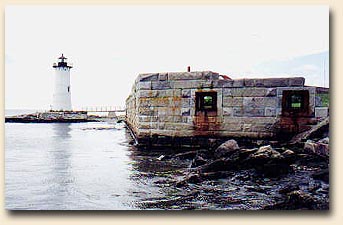 confront the gathering crowd. Atkinson demanded to know the purpose of the
gathering. When none of the crowd would respond, he announced that he
believed that they planned to attack Fort William and Mary and warned that
"they were going about an Unlawfull Act to take away the Powder out
of his Majestys Fort, and that it was the highest Act of Treason and
Rebellion They could possibly commit, And that they would be answerable
for such an Offence for twenty years to come - Nay, as long as they lived
. . ." [10] Atkinson's speech did not have the desired result. In
fact, merchant John Langdon - a future governor of New Hampshire and the
first President of the United States Senate - publicly ridiculed the old
Chief Justice before leading the crowd off to Newcastle Island, two miles
distant. [11] Within twenty-four hours of Paul Revere's message, the
Portsmouth Committee had openly, unlawfully and with utter disregard for
British authority, gathered over four hundred citizens of Portsmouth,
Newcastle, Rye, and Kittery, Maine to join in an armed attack on a British
fort.
confront the gathering crowd. Atkinson demanded to know the purpose of the
gathering. When none of the crowd would respond, he announced that he
believed that they planned to attack Fort William and Mary and warned that
"they were going about an Unlawfull Act to take away the Powder out
of his Majestys Fort, and that it was the highest Act of Treason and
Rebellion They could possibly commit, And that they would be answerable
for such an Offence for twenty years to come - Nay, as long as they lived
. . ." [10] Atkinson's speech did not have the desired result. In
fact, merchant John Langdon - a future governor of New Hampshire and the
first President of the United States Senate - publicly ridiculed the old
Chief Justice before leading the crowd off to Newcastle Island, two miles
distant. [11] Within twenty-four hours of Paul Revere's message, the
Portsmouth Committee had openly, unlawfully and with utter disregard for
British authority, gathered over four hundred citizens of Portsmouth,
Newcastle, Rye, and Kittery, Maine to join in an armed attack on a British
fort.