Olde Tyme Bottles |
|
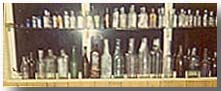
Photo, below: The only photo remaining which shows some of our bottles on display.
When my friend told me of someone who had 'old' bottles to give away, I was interested! We made plans to visit the woman and I was amazed! We lived near San Bernardino, a city that began with a Mormon settlement in the 1800's about 50 miles east of Los Angeles. It was now sometime in the early 1970s. They had recently excavated an area in the heart of the city to build a parking structure for a new shopping mall, and they allowed members of a bottle collecting club to detect and dig in the evenings when they finished work. Although she had been collecting bottles for many years, many of the best finds in her collection had come from the excavation for the parking structure. The collection this woman had amassed was incredible. Entire collections of intricately decorated children's 'tea sets' caught my eye, as did light bulbs old enough to come to a point on the top (unbroken). There was much china that had come to California by ship from China and England, and many unusual and unique bottles. I took home boxes of bottles, to my husband's dismay. I began researching the old areas of our county again, and gradually drew his interest. In obscure papers I located an old stage stop we drove out onto the desert to look for. It had been on the route traveled by wagon trains carrying gold and silver from the desert mines, including those from Panamint. Situated within site of the rocks now known as "Vasquez Rocks," the site was intact, much as the papers said it should be. The wagon tracks were still visible, cutting across the desert floor, a root cellar dug into the side of a bank was still there, and the trees from a spring frequented by Indians were still in place. We did not know enough to know that the site had been gone through pretty thoroughly, but when my three sons called me to see a rock where Indians had ground corn, it was obvious that people had been digging around the base, but had given up due to the size of the rock. We were thrilled to find an intact Lea & Perrin's Worcestershire bottle, complete with glass stopper, that day. But little did we know of the treasure we missed. Several years later, my husband was leafing through a treasure magazine someone had brought to work, and there was the grinding rock, which had been removed, and a cache of gold buttons which was discovered underneath, worth about $20,000!!! The next summer, while fishing and camping at Lake Isabella, one of the boys brought something to me that he'd found bobbing along the shoreline. It was a small bottle, with the cork top shoved down inside the neck, which caused it to float. Using the new-found knowledge that I'd learned about bottles, I could see that the seam line of the mold ended at the bottom of the neck, and then the bottle had been stretched up to form the neck, and the ring of glass at the top had been applied separately. It was very crooked, light green in color, and full of air bubbles. As I examined it, I recalled that an old town had been buried when the dam built and the lake formed. I realized that the bottle must have come from the dump of that town. The lake was very low that year, and it was possible that the river above the lake was cutting through the dump. After talking the theory over with my husband we gathered up the family, jumped into the car, and drove up the road that skirted the lake. As we reached a point where the upper end of the lake began, it was obvious just how low the lake was that year, and we watched carefully for a road in which to get down to the river now flowing through what was lakebed. At the first opportunity we pulled down in and walked down to the river, checking downstream first. You can imagine my surprise when we actually found the dump within a few minutes, with the river cutting into the side of it, the broken glass and tin on the fresh face at the creek's edge made it obvious. We had nothing to dig with, but the sand was soft and damp, so I used a piece of thick heavy glass, and began carefully digging. It was fascinating! As you carefully began to uncover a bottle, you unconsciously held your breath, hoping it was whole and perfect... and most times it was not. But, we began finding some which were, and they kept us going. Friends were with us, and the kids all played in the area while all the adults were busy digging in the sand... then my youngest son, who had taken his sandals off, against orders, almost sliced his foot off, and we quickly carried him and the bottles to the car, headed for the nearest hospital. By the time we made it back to camp it was dark, and that night his temperature climbed to 104 degrees. I called the hospital at home, and they said we'd better bring him back, so we packed up and headed home. He was on crutches for 6 weeks, and it was a total of two months before my husband and I could manage to get back up there without the children. By that time it was fall, the lake had risen, and the dump was underwater again. I found these old bottles fascinating. The first bottle that washed up at Lake Isabella, I was later told, was one of the oldest that we had, and could have been old enough to have been part of Fremont's original expedition into that area. A piece of history that can never be replaced, most of them have little monetary value, but again, they provide that elusive touch with the past. Picturesque names and hand-applied glass labels made them endearing. Some were given to us, some we found, and some we bought. If they were for sale and no one would buy them, I adopted them so that they might not disappear. I still find it hard to pass them up. and have given boxes of them away to family and friends, and still keep one box for myself, even though I have no place to display them at this time. We continued investigating old bottles a bit, but I worked half-days, and with three sons--two of them in their teens, there was little time. Then, one of the guys my husband worked with began talking about some of the stories he'd been reading about gold. And, many of the places where we went looking for bottles were old mining towns... so, we arranged a trip to the desert, and the rest was history. If you are interested in collecting old bottles, there are resources available on the internet. Here are a few sites to start you off... Note: Since I wrote this, there are "Antiquities Laws" that have gone into effect, and you will want to be sure to see what the regulations are in any area before searching for bottles. A rockhounding site with good info: http://www.rahul.net/infodyn/rockhounds/rockhounds.html
|